
When Your RV Batteries Keep Going Dead
RV batteries are one of those things I have always considered someone else’s department. In our RV, electricity is Doo Doo’s department. He understands it. I don’t. There comes a point when you know your weaknesses, and electrical systems are definitely one of mine.
But writing this RV power series has taught me there is a difference between knowing how to troubleshoot an electrical problem and understanding what the system is supposed to do. If you’re wondering, why won’t my RV batteries hold a charge, you don’t have to become an electrician to understand the basic possibilities.
Your batteries are part of a larger electrical system. Before assuming you need new batteries, it helps to understand how electricity gets into them, what can use that electricity, and what happens as batteries age.
Let’s keep this simple.
What Are Your RV Batteries Supposed to Do?
Your RV house batteries store 12-volt DC electricity. That stored electricity can power the 12-volt side of your RV when you’re not connected to shore power. If your RV has an inverter, battery power can also be converted into 120-volt AC electricity for certain appliances or outlets.
If you’re wondering how all of those pieces fit together, Why Does My RV Have 2 Kinds of Electricity? is a good place to start.
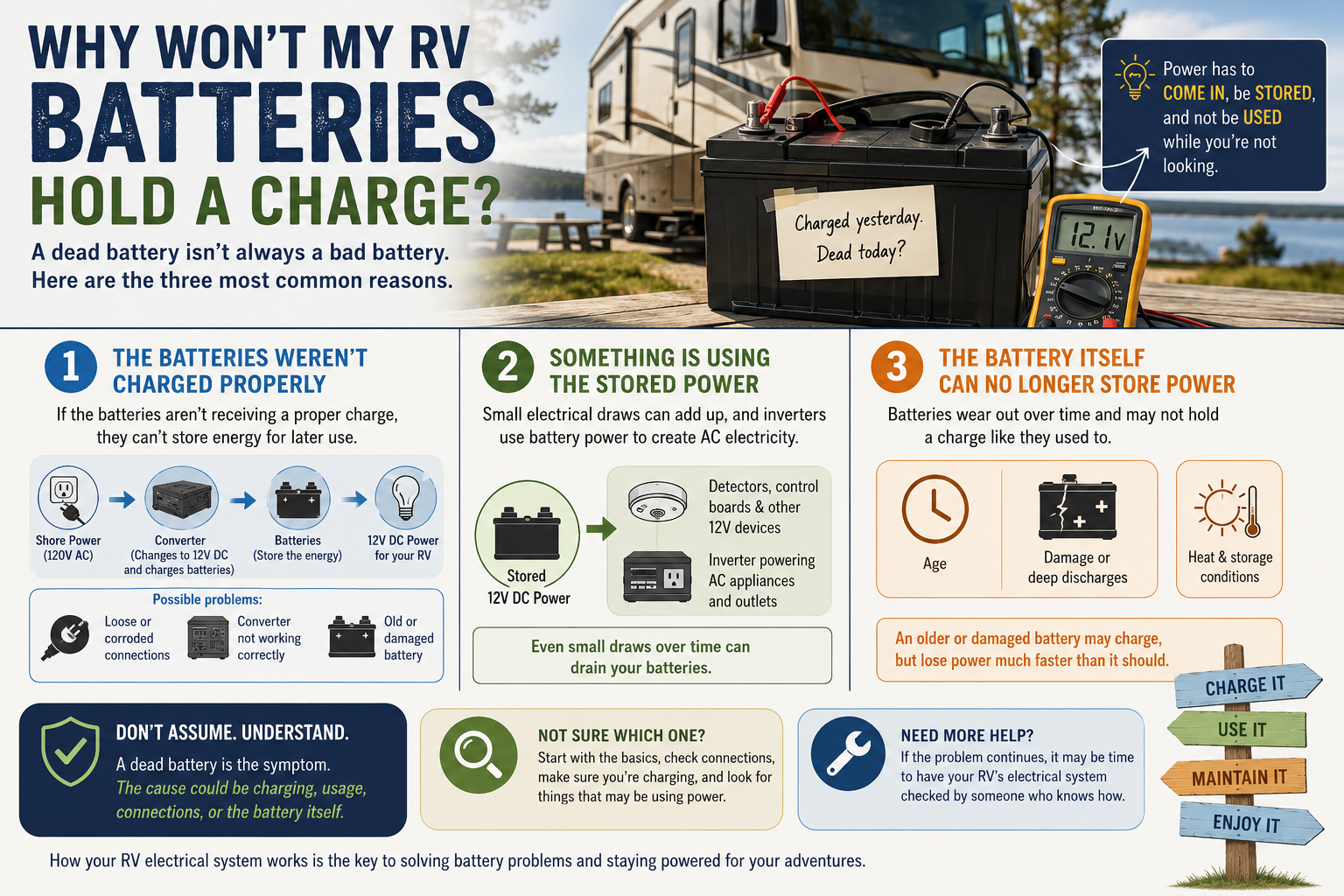
The important word here is stored. Your batteries don’t make electricity. They store energy supplied to them so it can be used later. That means a battery that keeps going dead doesn’t automatically mean you have a bad battery. The problem could be how the battery is being charged, how the stored electricity is being used, or the battery itself.
Was the RV Battery Actually Charged?
This is the first part of the system that makes more sense to me after learning what a converter does. When your RV is connected to shore power, the converter is normally involved in supplying the 12-volt system and charging the house batteries.
What Is an RV Converter? explains that process in much more detail, but the basic idea is that the converter changes 120-volt AC electricity into the 12-volt DC electricity your RV needs. So if a battery isn’t charging properly, the battery itself isn’t necessarily the only possible problem.
There could be an issue somewhere in the charging system. A connection could be loose or corroded. The converter may not be charging properly. There could also be a problem with the battery itself.
For a beginner, the important lesson isn’t learning how to diagnose every possibility. It’s understanding that being plugged into shore power and having a properly charged battery aren’t necessarily the same thing if something in the system isn’t working correctly.
Is Something Using the Battery Power?
Here’s another possibility that is easy to overlook. Maybe your battery can hold a charge. Something may simply be using it. RVs can have small electrical loads even when it seems like everything is turned off. Depending on the RV, things such as detectors, control boards, and other equipment can continue drawing small amounts of 12-volt power. One tiny electrical draw may not seem significant. Leave an RV sitting long enough, though, and those small draws can add up. An inverter can also use stored battery power.
As we explained in What Is an RV Inverter?, an inverter takes 12-volt DC electricity stored in the batteries and changes it into 120-volt AC electricity that certain appliances and outlets can use. That electricity has to come from somewhere. Every time battery power is being used, some of the stored energy is leaving the battery.
So a battery that is dead after the RV has been sitting may not have suddenly lost its ability to hold a charge. The RV may have been slowly using the electricity that was stored in it.
Can an RV Battery Go Bad?
Yes. Sometimes the battery really is the problem. RV batteries don’t last forever. As they age, they can gradually lose their ability to store as much energy as they once did. Eventually, a battery may appear to charge but lose power much faster than it should.
How long an RV battery lasts depends on several things, including the type of battery and how it has been used and maintained. We’ll take a closer look at battery lifespan separately. For now, the important thing to understand is that an older or damaged battery may simply no longer be capable of holding the charge it once could.
What About Battery Connections?
Sometimes the problem isn’t inside the battery at all. The battery has to be properly connected to the RV’s electrical system to receive and deliver power. Loose connections, corrosion, or damaged cables can interfere with that process.
You don’t need to start taking your battery system apart to understand why this matters. Electricity needs a good path to travel through the system. If that path has a problem, the symptoms can look like a battery problem even when the battery isn’t the only thing that needs attention. This is also a good example of why replacing a battery isn’t always the first answer to an electrical problem.
Why Do RV Batteries Die in Storage?
Storage adds another wrinkle because the RV may sit for weeks or months without being connected to shore power. If something continues drawing electricity during that time, the house batteries can gradually discharge.
Many RVs have a battery disconnect system that can help reduce power use during storage. However, RV electrical systems vary, and a battery disconnect doesn’t necessarily mean every possible electrical load has been removed on every RV. How batteries should be stored also depends on the type of batteries you have and your RV’s electrical system.
This is one of those times when knowing your particular RV matters more than following a rule you saw someone post online. Your owner’s manual and battery manufacturer’s instructions should tell you how your particular batteries should be maintained during periods when the RV isn’t being used.
How Do I Know Which Problem I Have?
This is where I’m perfectly comfortable saying that understanding the basics and diagnosing the problem are two different things.
If your RV batteries repeatedly go dead, you now know the basic questions that need to be answered.
Did the batteries receive a proper charge?
Is something using the stored electricity?
Can the batteries still store the amount of energy they should?
Is there a problem somewhere in the connections or charging system?
Answering those questions may require actual electrical testing. If you’re comfortable doing that and know how to work safely around RV electrical systems, that’s the next step. If you’re like me and electricity falls firmly into the “not my department” category, knowing how the system works still helps. You can recognize that repeatedly replacing batteries without determining why they’re going dead may not solve the real problem.
Don’t Assume a Dead Battery Is a Bad Battery
This is probably the biggest thing to remember. If your house batteries are dead, they may indeed need replacement. But “dead” describes their current state. It doesn’t tell you why they got there. Maybe they weren’t being charged correctly. Maybe something used the stored electricity. Possibly a connection is causing trouble. Or maybe the batteries have reached the point where they can no longer store enough energy. Those are very different problems that can produce a similar result.
Understanding that difference can save a lot of frustration—and possibly keep you from buying batteries when batteries weren’t the problem in the first place.
Final Thoughts
So, why won’t my RV batteries hold a charge? There isn’t one answer. Your batteries are only one part of your RV’s electrical system. They have to receive electricity, store it, and then supply it when the RV needs it. If they keep going dead, start by thinking about that path rather than immediately assuming the batteries have failed. Were they properly charged? Is something drawing power? Can the batteries still store the energy they’re receiving? Is something else in the charging system preventing them from doing their job?
You don’t have to know how to repair every part of an RV electrical system to understand those basic questions. I’m certainly not volunteering to take over the electrical department in our RV anytime soon. But after learning how shore power, converters, inverters, and batteries connect to one another, I at least understand what that department is doing.
And that’s a pretty big improvement.
Leave a Reply