
The Part of Your RV Electrical System You Never See
For a long time, I thought plugging our RV into shore power worked pretty much like plugging an appliance into an outlet. You plug it in. Electricity comes through the cord. Everything has power. Simple enough.
What I didn’t realize was that quite a bit was happening behind the scenes. An RV doesn’t use just one kind of electricity, so the power coming through that shore power cord can’t simply run everything in the RV exactly as it arrives. That’s where the RV converter comes in.
I had heard the word converter before, but I couldn’t have told you what it did, where it was located, or how it fit into our RV’s electrical system. And don’t even get me started on the difference between a converter and an inverter. Those two words have confused me for years.
So if you’re wondering what is an RV converter, we’re going to keep this simple. No electrical engineering required.
First, Remember Your RV Has Two Electrical Systems
Before a converter makes sense, you need to know one basic thing about RV electricity. Your RV uses both 120-volt AC electricity and 12-volt DC electricity. The campground pedestal supplies 120-volt AC electricity when you’re connected to shore power. Your RV’s house batteries supply 12-volt DC electricity. Different parts of your RV are designed to use one or the other. If that is already starting to sound confusing, Why Does My RV Have 2 Kinds of Electricity? explains 120-volt AC and 12-volt DC power in beginner-friendly terms.
For now, all you really need to remember is this: The campground gives your RV AC power, but many systems inside your RV need DC power. Something has to bridge that gap. That’s the converter.
What Does an RV Converter Do?
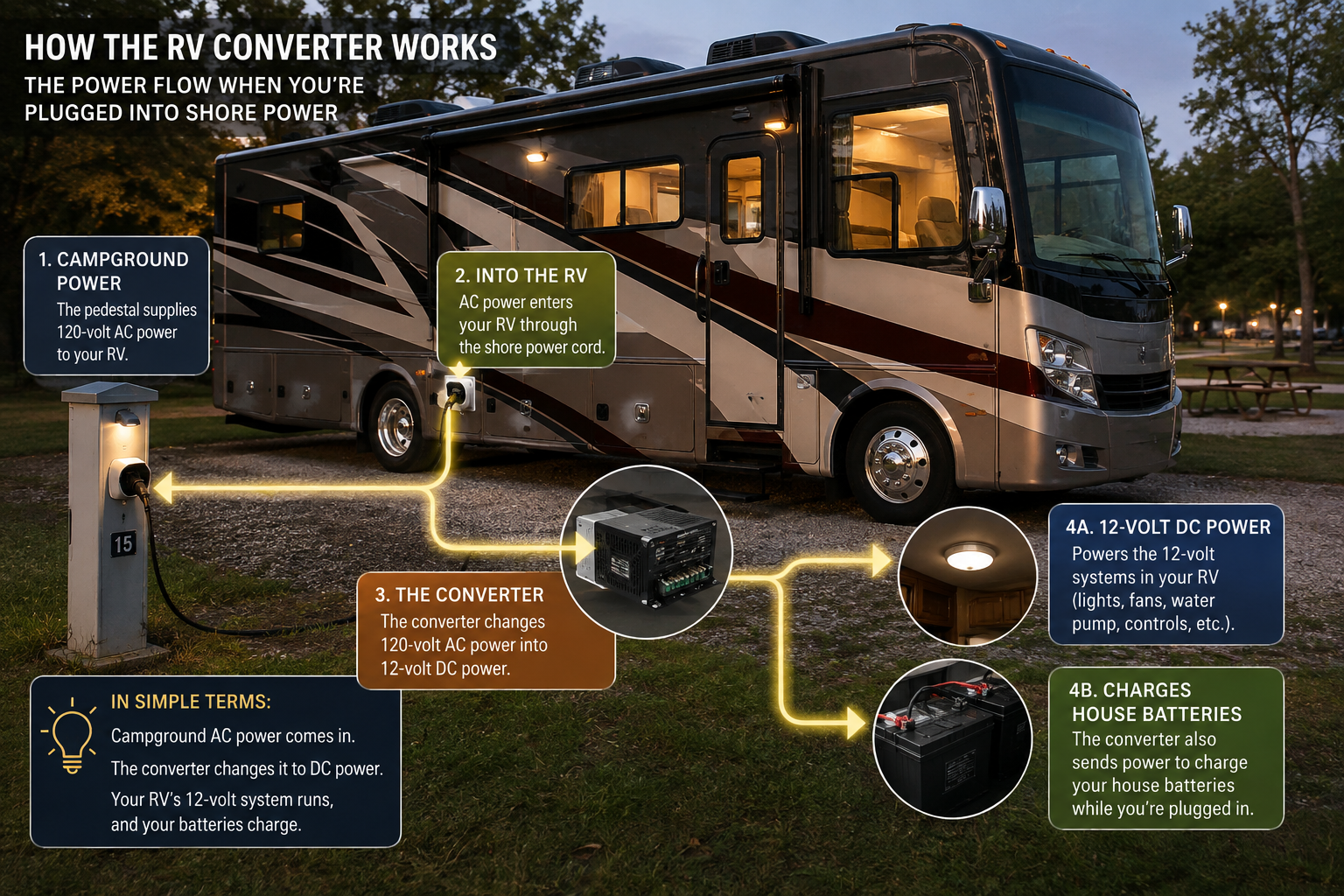
An RV converter takes 120-volt AC electricity and converts it into 12-volt DC electricity. That’s really the heart of the answer. When you’re connected to shore power, electricity enters your RV as AC power. Your converter takes some of that AC electricity and changes it into the DC electricity needed by the 12-volt side of the RV.
That DC power can then supply things such as your interior lights, water pump, vent fans, and various RV control systems. Exactly what operates on 12-volt power will depend on your RV. The converter also helps keep your house batteries charged while you’re connected to shore power. And suddenly, the name makes a little more sense. It’s called a converter because it converts electricity from one form into another: AC to DC. That’s the part I wish someone had told me years ago.
What Happens to the Converter When I Plug In?
For most of us, absolutely nothing noticeable. And I think that’s part of the reason converters can remain a mystery for so long. You pull into the campsite, connect your shore power cord, turn on the campground pedestal breaker, and go about setting up camp. Meanwhile, the converter is doing its job in the background.
The 120-volt side of the RV receives AC power for things designed to use it. At the same time, the converter supplies DC power to the RV’s 12-volt system and helps charge the house batteries. What Happens When I Plug In My RV? takes a closer look at everything that starts happening once your RV is connected to campground electricity.
I didn’t realize any of this when we bought our first RV. As far as I knew, plugging the RV into the campground pedestal was the RV equivalent of plugging a toaster into the kitchen wall. Power cord plugged in. Electricity on. There was a lot more happening behind the walls than I realized.
What Does the Converter Have to Do With My House Batteries?
This is another connection I didn’t understand as a new RV owner. Your converter and house batteries work together as part of the RV’s 12-volt electrical system. While you’re connected to shore power, the converter can supply the RV’s 12-volt needs while also charging the house batteries. That helps keep the batteries ready for times when shore power isn’t available. This is also why a problem with an RV’s 12-volt system can be confusing.
If the lights aren’t working correctly or the house batteries aren’t staying charged, there are several possible reasons. The batteries themselves could be the problem, but the converter or another part of the charging system could also be involved. That doesn’t mean you need to know how to diagnose or repair a converter. At this point, we’re just learning what the thing does.
Where Is the Converter in My RV?
I have no idea where ours is. And that’s probably not unusual. Unlike the shore power cord or campground pedestal, a converter isn’t something most RV owners interact with every time they camp.
Depending on the RV, the converter may be incorporated into or located near the RV’s electrical distribution center, or it may be a separate component installed elsewhere. RV designs vary, so there isn’t one location where every RVer can go looking for it. If you want to know exactly where your converter is located, your RV owner’s manual or electrical documentation is a better place to start than taking panels apart looking for it. You don’t need to physically find the converter to understand its job.
Is a Converter the Same as an Inverter?
No.
This is where the terminology becomes unnecessarily cruel to beginners. Converter. Inverter. Two electrical devices with almost identical names doing different jobs. The easiest way I’ve found to keep them straight is to remember what we’ve already learned about the converter: A converter takes AC electricity and converts it to DC electricity.
An inverter essentially works in the other direction. It can take DC electricity stored in your batteries and create AC electricity that certain appliances or outlets can use. There is more to understand about inverters, so we’ll give that topic its own beginner explanation rather than trying to learn both at once.
For now, just remember: Converter = AC to DC.
That’s enough.
Why Do I Need a Converter If I Have House Batteries?
This question makes much more sense once you understand that batteries don’t create an endless supply of electricity. Your house batteries store DC electricity. As that stored energy is used, the batteries need to be recharged. When you’re connected to shore power, the converter allows your RV to use the campground’s AC electricity to support the 12-volt system and recharge the house batteries. Without some way to convert that incoming AC electricity to DC, plugging into a campground pedestal wouldn’t by itself provide the kind of electricity the 12-volt side of your RV needs. The converter is one of the pieces quietly connecting those two electrical worlds.
Do I Need to Do Anything With My RV Converter?
Under normal camping conditions, probably not. For most RV owners, the converter isn’t something you turn on every time you arrive at a campsite. It generally does its job automatically when the appropriate AC power is available. That’s why you can use an RV for quite a while without understanding what a converter is. You don’t need to monitor it every time you plug in, and you certainly don’t need to understand its internal electronics just to go camping.
But knowing that it exists can be helpful if you ever have trouble with your house batteries or 12-volt system. Instead of thinking, “I’m plugged into shore power, so why aren’t my batteries charging?” you at least know there is another piece of equipment between those two things. And sometimes simply knowing which questions to ask makes an RV problem a lot less intimidating.
Final Thoughts
So, what is an RV converter? At its most basic, it’s the part of your RV electrical system that takes 120-volt AC electricity and converts it into 12-volt DC electricity your RV can use. It helps supply the 12-volt side of the RV while you’re connected to shore power, and it helps keep your house batteries charged. That’s it.
There is plenty more we could learn about converters, but we don’t need all of it today. If you’re new to RV electricity, start with the simple version: your RV uses two kinds of electricity, and the converter helps them work together by changing AC power into DC power.
For Converter 101, that’s enough to get us camping.
For further reading: