
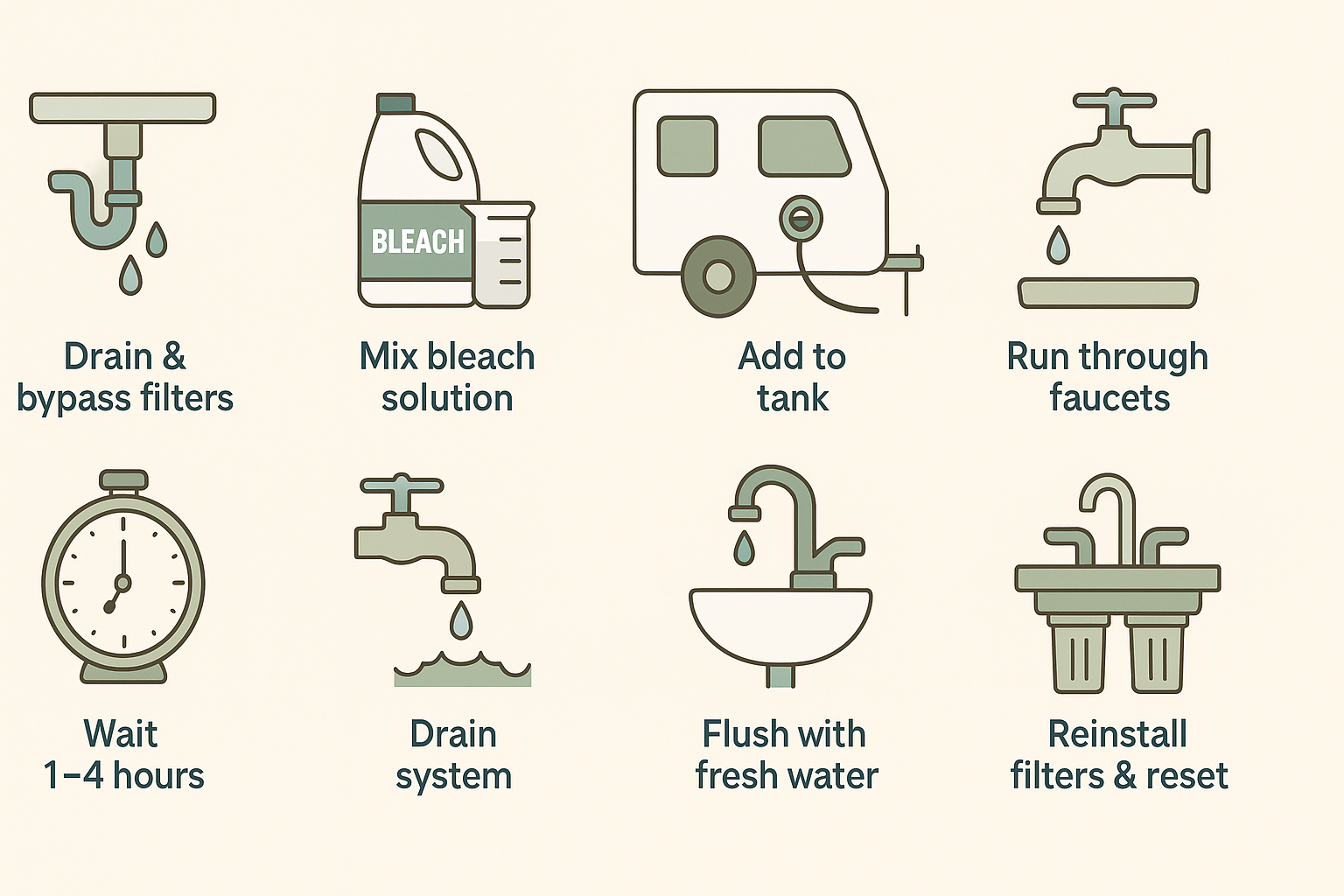
Fresh, safe water makes every camping weekend easier—enabling cooking, brushing teeth, and enjoying morning coffee, among other things. Sanitizing your RV’s fresh water tank and lines may sound intimidating, but it’s actually a straightforward process: a careful rinse with the right strength of household bleach, followed by a thorough flush afterward. Below is a friendly, detailed walkthrough that you can follow at your own pace, along with guidance on how often to do it, signs that it’s time, and fixes for common issues.
How Often Should You Sanitize Your RV Fresh Water Tank?
At a minimum, sanitize the system at least once a year and whenever it has been idle (after storage or de-winterization), after purchasing a used rig, and whenever you connect to a questionable water source. Many RVers also do a mid-season refresh for peace of mind. (Manufacturer guidance commonly calls for at least annual disinfection and after storage.)
Why Sanitize?
Even if your water looks clear, tiny amounts of organic material can still allow a biofilm to form in tanks, lines, and faucets. That can lead to stale odors, odd tastes, and—worst case—microbes you don’t want in your coffee. A periodic sanitize resets everything, so your tank and plumbing start clean. If you’re still getting familiar with how your RV water system works, this simple guide to RV tanks breaks down how fresh, gray, and black tanks all work together.
Safety First (Quick Checklist)
- Use regular, unscented household bleach only, with 5-9% sodium hypochlorite. Avoid “splash-less,” gel, or scented products because their percentages of sodium hypochlorite are too low for sanitization. Wear gloves, ventilate the area, and follow the label directions. I had a difficult time finding the correct type of bleach with the correct percentage of sodium hypochlorite. At the time of this post, I found this one on Amazon that met the criteria.
- Never mix bleach with vinegar or any other cleaner in the same container (that can create dangerous fumes).
- Bypass or remove any water filters before sanitizing (you’ll reinstall/replace them after you’re done). Many manufacturers’ procedures explicitly instruct you to remove the cartridge and sanitize it separately.
How Much Bleach? (Two Easy, Manufacturer-Style Options)
You can use either of these equivalent, industry-standard approaches—pick the one that’s easiest for you:
Option A — Premix by the jug (Winnebago/NFPA-style):
- Mix ¼ cup of bleach with 1 gallon of water to make a sanitizing solution.
- Add 1 gallon of the above solution for every 15 gallons of tank capacity to achieve ~50 ppm free chlorine (let it sit 4 hours).
- To shorten the wait, use ½ cup of bleach per gallon for the premix and add 1 gallon per 15 gallons of capacity to achieve ~100 ppm (let it sit for 1 hour).
Option B — “Quick formula” (Airstream-style):
- Calculate ounces of bleach = 0.13 × total system gallons (tank + water heater if included). Example: 60-gal system → 0.13 × 60 = 7.8 oz of bleach (approximately 1 cup). Let stand 3–4 hours; double the amount for a 1-hour contact time.
Tip: Bleach strength varies by brand; the methods above are designed around typical 5–6% household bleach and align with common RV manufacturer procedures.
Step-By-Step: How To Sanitize Your Freshwater Tank & Lines
Follow these numbered steps in order. Read them once before you start; then go one step at a time.
- Park and prep
- Be at a site with a sewer hookup (or a dump station plan).
- Turn the water heater off and let it cool. (You’ll run hot and cold lines later.)
- Bypass filters
- Remove any point-of-entry or under-sink filter cartridges to prevent bleach from damaging them. Leaving the canisters installed but empty. (You’ll replace cartridges after flushing.)
- Decide whether to bypass the water heater
- If your rig has a water center panel, turn it to the winterize/bypass position before adding the bleach solution. This prevents filling the water heater with a high concentration of chlorine while you’re dosing the system. You’ll still run hot faucets later to pull treated water through the lines when it has been diluted.
- Mix the sanitizing solution
- Choose Option A or Option B from the section above and mix in a clean container that you use only for water/bleach jobs. (Metal or glass measuring cups are easiest to clean.)
- Get the bleach into the tank (choose one method)
- Siphon/winterize hose: Place the pickup tube in your premix and use the pump to draw the mixture in.
- Cartridge canister method: With the filter cartridge removed, pour the measured bleach into the empty canister. Reinstall the cartridge and fill the tank—the bleach is carried in as the tank fills.
- Upright-hose method: Carefully pour bleach into the end of your potable hose, held upright, attach it, and then fill the tank so that the bleach is flushed in. (This also sanitizes the hose.)
- Fill with potable water
- Fill the tank completely with safe water.
- Run every faucet
- Turn on the pump, one location at a time, and open the cold and hot faucets (sink, bathroom, shower, outside shower, sprayers) until you smell chlorine. Then, close them. Don’t forget the toilet valve.
- Wait for contact time
- 50 ppm → 4 hours, or 100 ppm → 1 hour. Use what you prepared above. Keep the rig ventilated.
- Drain the system
- Open low point drains and run faucets to move treated water into the gray/black tanks (as appropriate) and then to the sewer hookup/dump station. Don’t discharge chlorinated water onto the ground, and check with park staff before putting strong solutions into a septic system.
- Flush with fresh water
- Refill the tank with clean water. Open each faucet again until the chlorine smell fades. You may need two or more full flushes to remove the odor.
- Optional: neutralize lingering smell
- If a light bleach smell lingers after several flushes, run a vinegar rinse through the lines: mix 1 quart of white vinegar in 5 gallons of water, pump it through, let it sit for 15–30 minutes, then flush with water again.
- Restore the system
- Reinstall/replace the filter cartridges (many manufacturers recommend a new cartridge after sanitizing). Return the valves to their normal position (undo any bypass) and turn the water heater back on.
Telltale Signs Your Tank Needs Sanitizing
- Musty, swampy, or sulfur (“rotten egg”) smell from cold taps.
- Odd taste in cold water that is used for drinking or brushing teeth.
- Cloudiness or fine particles after the system sits for a week or two.
- A slimy feel on faucet aerators or a pinkish film (biofilm) around fixtures.
- Recent questionable water source or long storage.
If you see these, sanitize now and consider replacing the main sediment/carbon filter after you’re finished.
Common Issues & Easy Fixes
- “I still smell bleach.” Keep flushing with fresh water. If needed, do the vinegar rinse once, then flush again. Also, make sure you reinstalled a fresh carbon filter cartridge, which helps remove taste/odor.
- The water pump runs, but no flow after draining. Open a nearby faucet fully (start with the cold water first), allow the pump 20–30 seconds to prime, and then close it once the stream is steady. Check that low-point drains are fully closed.
- Weak flow at one faucet. Unscrew the faucet aerator and rinse out debris dislodged during sanitizing.
- Bleach ruined my filter. That happens—chlorine can damage carbon cartridges. Remove/bypass cartridges before sanitizing and install new ones after you flush.
- Using something other than bleach. Some RVers use hydrogen peroxide, vinegar, or specialty products. Bleach remains the most widely supported method at typical RV strengths. If you choose alternatives, follow the product directions and be aware that they may require heat or longer contact times to achieve the same effectiveness as bleach.
Pro Tips and Extra Good Habits
- Sanitize the hose, too. Feeding your premix through the potable-water hose also cleans the hose interior.
- Keep it regular. Add sanitizing to your seasonal checklist: after storage, after any plumbing work, and anytime the water tastes or smells “off.”
- Need the math fast? For a ballpark estimate, using 1 cup of bleach per ~60 gallons of total system (tank + water heater) aligns with many OEM guidelines. Alternatively, use 0.13 × total gallons = ounces of bleach for a 3–4 hour contact time.
- Don’t forget the outside shower and any spray ports. They’re easy to overlook and can re-contaminate the system if skipped.
- Label your measuring tools (e.g., “Bleach Only”) and store them with your potable-water kit so they don’t end up in the kitchen drawer.
Next Steps for RV Water System Basics
Now that your fresh water system is clean, the next step is making sure the rest of your RV system is working just as smoothly. These guides will help you feel confident at the campsite:
– How to hook up an RV sewer hose
– Black tank basics and maintenance
Final Thoughts
The importance of sanitizing your fresh water tank cannot be overstated. Include sanitizing your fresh water tank as part of your yearly maintenance at a minimum.
**Note: After researching for this blog post, the most reliable information was found on the Winnebago website and the Air Stream Life website. There is a great deal of misinformation on the web that could harm your RV plumbing, which differs from the plumbing in your house.